
5 Questions for Dr Marc Loewer
— Meditation teacher and psychotherapist —
March 2026

In our 'Five Questions for...' series, we introduce the course leaders who teach at Landgut Ried. First up is Marc Loewer, a meditation teacher and psychotherapist who incorporates insights from psychology and neuroscience into his meditation retreats. In this interview, we discuss mindfulness, the wandering mind, loving awareness and how meditation can act as an inner compass in a complex world.
‘What does “arriving at your true home” mean to you, and how can you recognize it in everyday life?’
Perhaps I’ll start by clarifying something fundamental.
According to the spiritual traditions I practise and teach in my retreats, the nature of our mind is pure consciousness or awareness. This awareness is free from fixations; it is insubstantial yet clear and knowing. On the one hand, it is what we truly are in our deepest essence. On the other hand, due to our conditioning, we lose ourselves in the views and projections of our mind.
Recognising this awareness within us and becoming familiar with it is part of the practice path, which we also explore during the retreat. On this path, we explore our mind and all its projections and resistances. This can sometimes be arduous and exhausting. However, if we persevere, we can learn a great deal about ourselves, and this knowledge can sustain us in everyday life.
Recognising and becoming familiar with our true nature, and increasingly dwelling within it, is profoundly liberating. We discover an inner freedom that is often obscured in everyday life by our habitual thoughts and behaviours. This creates the possibility of not only living more freely, but also of truly making friends with ourselves and viewing the world with more love.
Now, let's consider this in more concrete terms with regard to everyday life.
Our mind is constantly on the move. It wanders into the past or the future, rarely staying in the present moment where life is actually happening. This manifests itself in our struggle with unwanted situations or our tendency to daydream about other places: our next holiday, a different relationship, a more fulfilling job, having more time to ourselves, or the next retreat.
'Arriving at your true home' means being where life is happening right now.
How can we achieve this? Spiritual traditions offer many different approaches. Yet the sheer variety of methods can also be overwhelming. That is why I like to start very simply: right now, as you read these lines, feel your body. Feel your breath. Become aware that you are reading.
This is about turning our attention to the present moment as it unfolds. We cannot hold on to this moment; the 'now' of this instant has already passed. However, we can experience the present moment through the process of awareness.
This realisation is radical because it involves stepping outside our habitual patterns of thought and behaviour, yet it is so simple that we constantly overlook it. The practice consists of recognising awareness, becoming familiar with it and repeatedly returning to it.
During the retreat, I teach practical exercises that interrupt our habitual thought patterns directly. These exercises open up the possibility of recognising what lies behind thoughts, or more precisely, the source of thinking itself. This practice is simple yet not easy. It is precisely because of its simplicity that we overlook it in everyday life. That is why it is important to familiarise ourselves with this way of encountering our mind again and again, even if only for brief moments.
As one of my teachers says, 'Short moments, many times.'
‘You speak of a bridge between Dharma and psychology/neuroscience. What does science actually clarify, and where do you think it is misunderstood or overused?’
Unlike Dharma traditions, which have engaged in the study of the mind for millennia, Western psychology is comparatively young. It is highly sophisticated in describing brain development and identifying patterns of disorder. However, it often focuses on pathology, or what is pathological, rather than the deeper potentials of our mind.
At the same time, renowned institutes are now researching meditation and its effects on the brain. Some of the research involving long-term meditators is yielding surprising results. Long-term meditation appears to alter not only short-term mental states, but also deeper neural patterns (neuroplastic changes), particularly in areas related to attention, emotional regulation, and compassion. Nevertheless, these approaches are still limited — partly for methodological reasons and partly because it is fundamentally challenging to objectively investigate something that is not an object. It is impossible to observe from the outside and experience from the inside simultaneously. Scientific methodology, by its very nature, operates within this subject–object separation.
In the direct exploration of the mind, however, we ask questions such as: Who is aware of this moment? When we look deeply enough, we discover something astonishing: awareness without any fixed entity that can be identified as seeing or observing. The so-called 'I' is a functional construct that is helpful in everyday life yet often an obstacle to our happiness.
The ego is always craving something. It is often dissatisfied and caught up in desire or aversion, feeling disconnected or powerless.
Interestingly, neuroscientific research also shows that activation of the Default Mode Network (DMN) is linked to a wandering mind. Studies suggest that a constantly wandering mind correlates with dissatisfaction. Certain meditation practices focus precisely on reducing DMN activation. This can lead to increased neuroplasticity and deeper learning. We can discover deeper connections and new perspectives in our lives.
From an evolutionary biology perspective, the brain is designed to recognise dangers and ensure social integration. However, in today's complex world, this system can become overactive.
For example, an overactive amygdala is associated with a chronic perception of threat and can intensify fight-or-flight responses. This is scientifically explained by altered connections to the prefrontal cortex, among other things. This knowledge can be helpful even if we have not experienced overt trauma or suffer from an anxiety disorder. It can support our meditation practice by helping us to learn how to regulate our nervous system and understand our reaction patterns rather than simply following them blindly.
Science sheds a great deal of light on mechanisms. Direct practice, on the other hand, enables us to gain experience. These two approaches can complement each other effectively, provided we do not expect one to replace the other entirely.
‘Loving Awareness: How does this differ from traditional mindfulness? Which exercises lead most directly to it?’
In an interview, Jon Kabat-Zinn told me that he sometimes prefers the term ‘Loving Awareness’ to ‘mindfulness’. If mindfulness is understood merely as a technique, it can become rigid or one-sided. The underlying attitude of love can be lost in the process.
One could also say that mindfulness is often object-oriented. We focus our attention on the breath, bodily sensations, or sounds. Awareness, in the sense of being aware, is more subject-oriented. Here, the focus is on the act of observing itself rather than on the object.
This becomes linguistically difficult because awareness is not an object. It is not something we can look at; it is that through which we look or that which looks.
Loving awareness therefore encompasses not only alertness, but also kindness and openness. It is a letting-be of whatever arises, sustained by a fundamental warmth.
Direct paths to this state involve simple, immediate questions such as: Who is aware of this moment? What is here before a thought arises? Also: Can I meet the present experience with kindness? This approach is less a technique and more an attitude – a return to our true home, which is already there.
‘The nature of the mind and non-duality: What are the most common pitfalls in self-inquiry, such as ‘Who am I?’, and how can one get back on the right track?”
Perhaps I do not fully understand the question, but I see a tendency to use the non-dual perspective unconsciously to avoid duality, and thus the concrete complexity of our lives.
'Everything is one' can become a subtle act of escape, taking us away from relationship conflicts, inner tensions, unresolved biographical issues and the everyday challenges of life.
However, a spiritual path that does not lead back into everyday life is ultimately misguided. This is how one of my long-standing teachers, the Zen Master Willigis Jäger, aptly put it.
From my experience of working in psychotherapy, I have seen how much people struggle with themselves and how great their longing is to escape the complexity of relationships, work, and inner contradictions. In such cases, a spiritual practice can be very healing. This is not achieved by negating these aspects, but by teaching us to engage with them in a more conscious and compassionate way.
In many therapeutic traditions, we talk about inner parts or modes. We are often very harsh with these parts of ourselves. We judge ourselves more harshly than we would judge a good friend, or even a stranger. Recognising this inner harshness is a crucial step.
Self-inquiry — asking ourselves 'Who am I?' — must not cause us to devalue or overlook our psychological self. A healthy, integrated self is not an obstacle to non-duality; it is its very foundation.
When we learn to relate to our inner self in a kind, clear, and responsible way, stability emerges. From this stability, we can experience non-separateness without it becoming a spiritual avoidance strategy.
Therefore, the right path is not an abstract state, but rather a willingness to take both the relative and absolute levels seriously: the unity of being and the concrete reality of our human lives.
‘In an age of information and digital overload, what inner compass can meditation strengthen without becoming a form of self-optimisation?’
Dealing with constant digital stimuli and the availability of endless information is a major challenge for many people, myself included. So much seems urgent and important, putting constant strain on our nervous system.
From an evolutionary biology perspective, our brain is designed to react to new things, potential dangers, and social cues. Digital media tap into precisely these mechanisms, often with an intensity that our system was not originally designed for.
Meditation can strengthen an inner compass that reacts less reflexively to external stimuli and makes decisions based on inner clarity rather than external influences. This compass is not performance-oriented, asking how we can become more efficient or better. Rather, it helps us to focus our attention on what is truly essential in the moment: what nourishes our lives and what exhausts us. When the mind is centred and at rest in the present moment, contentment arises quite naturally — not because everything is perfect, but because our attention is not constantly elsewhere.
This is how meditation strengthens our capacity for self-regulation: by pausing before reacting, decoupling stimulus and response, and consciously choosing what to focus our attention on. Without this conscious choice, attention becomes a commodity; with it, however, it becomes an act of inner freedom.
The difference from self-optimisation lies in the motivation: self-optimisation often stems from a sense of lack, the feeling that we are not yet enough. Meditation, on the other hand, begins with the quiet recognition that we are already here. From this attitude, a sense of direction emerges – not as pressure, but as calm, gentle clarity. Perhaps that is precisely the inner compass we need more than ever today.
Interview: Stefanie Weilenmann
From 1 to 5 July 2026, Marc Loewer will lead the ‘Coming Home Intensive – Discover Your True Home’ retreat at Landguet Ried. Set in peaceful and serene surroundings, this retreat offers an opportunity to encounter your own mindfulness practice directly. Through meditation, silent practice and mindful self-exploration, you will learn to recognize your habitual thought patterns, inner tensions and projections without judgement, and to approach them with greater awareness and kindness.
Would you like to experience this space of silence and awareness for yourself, as well as understand it? You can find all the details about the retreat with Marc Loewer here >>>
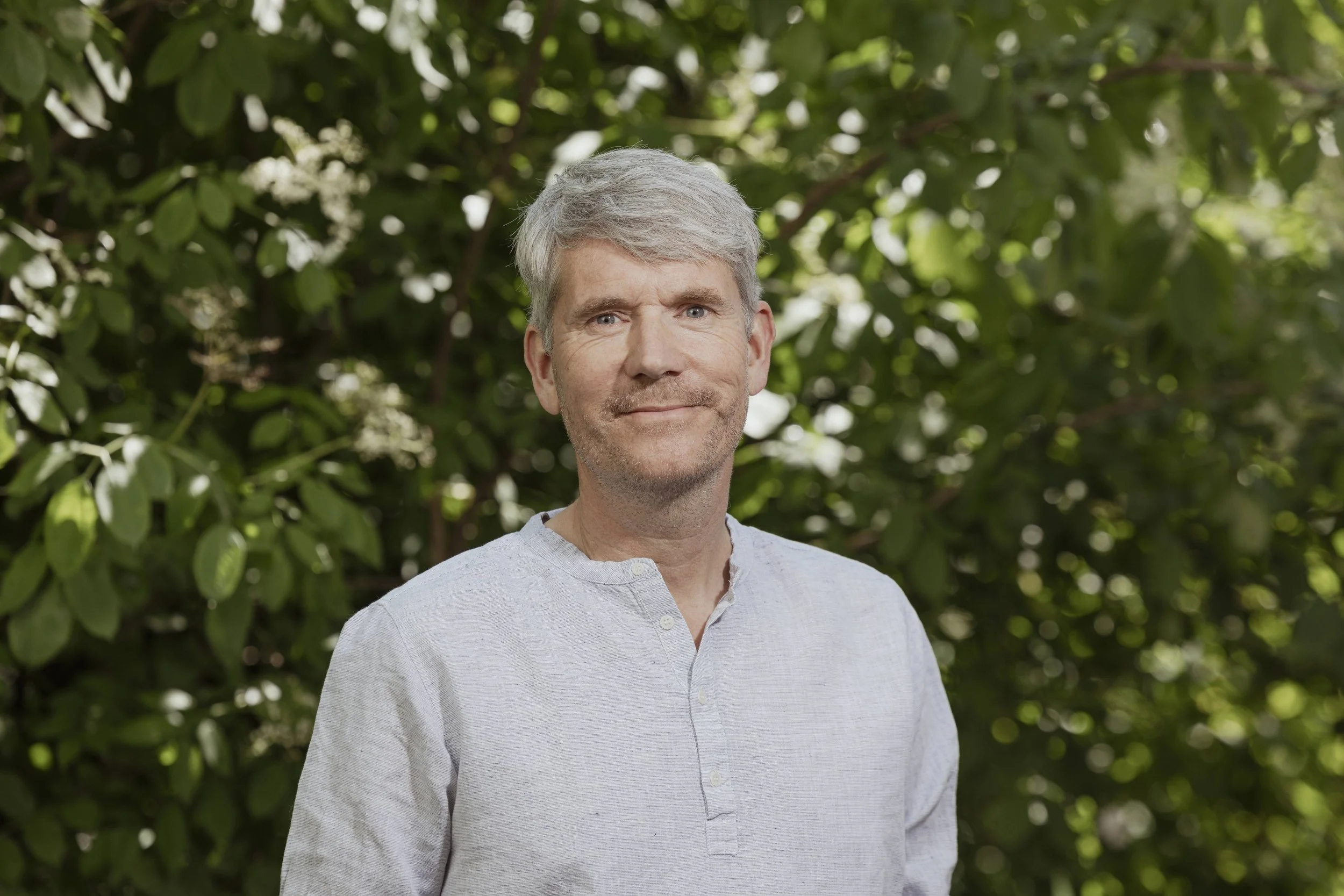
Marc Loewer is a psychiatrist and psychotherapist who runs his own practice in Freiburg im Breisgau. Over three decades ago, he was led to meditation by fundamental existential questions such as 'Who am I?' and 'What is the meaning of life?'.
His path has been shaped by the practice of non-dual wisdom traditions. Key teachers who have influenced and guided him include Papaji, Ramesh Balsekar, Willigis Jäger, Mingyur Rinpoche and Tsoknyi Rinpoche.
He combines Eastern meditation practice with the latest findings from neuroscience, Western psychology and psychotherapy in a refreshing way. He is the German-speaking voice of the ‘Mindfulness App’ and works as a senior-level MBSR and MBCT teacher. Marc is married and the father of two wonderful children.